While deploying a project I had developed half a year earlier with Laravel 5.2, I ran into quite a few problems. One of them: after running php artisan migrate, I got a “Table Already Exists” error. But I had never created that table before. Digging deeper, I found that the table did exist, but there was no record for it in the project_migrations table. So I deleted the table manually and ran php artisan migrate once more. Sure enough, this time the real error message appeared: “General error: 1005 Can’t create table ‘dbname.#sql-fbc1_15e6’ (errno: 121) (SQL: alter table karl_project add constraint project_user_id_foreign foreign key (user_id) references karl_user
(id))”
If you also get the Table Already Exists error, check whether the migrations folder has a record for it and whether the table actually exists. If that matches your situation, read on. Maybe you’ll run into the same problem I did!
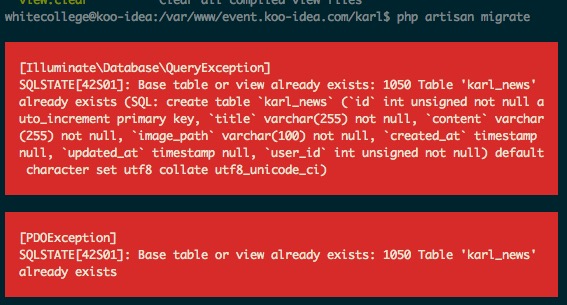
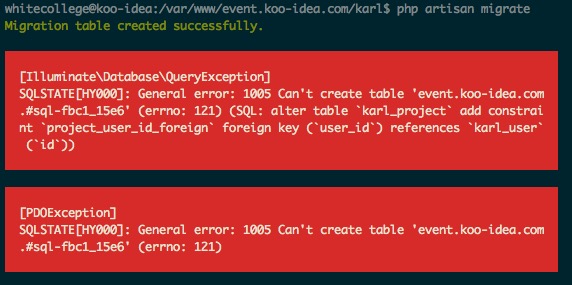
There are two possible causes. The first is that the MySQL engine must be set to InnoDB to use the foreign key feature. You can set this in the mysql engine setting in config/database.php. But Laravel uses InnoDB by default, so unless your database has a different setting, this should not be the cause. You can check whether the problem table uses the InnoDB engine with the SQL below:
SELECT TABLE_SCHEMA,TABLE_NAME,ENGINE FROM information_schema.TABLES WHERE TABLE_NAME = 'table_name';After checking, I found it was already InnoDB, so I ruled out that possibility.
Next I read through many more articles and found another possibility. In my migration files, I usually write foreign keys like this, creating the foreign key at the same time as the table:
Schema::create('project', function($table){
    $table->increments('id');
    $table->string('project_name', 100);
    $table->string('author', 100);
    $table->timestamps();
    $table->integer('user_id')->unsigned();
    $table->foreign('user_id')->references('id')->on('user');
});Schema::create('project', function($table){
$table->increments('id');
$table->string('project_name', 100);
$table->string('author', 100);
$table->timestamps();
$table->integer('user_id')->unsigned();
});
Schema::table(’news’, function($table) {
$table->foreign(‘user_id’)->references(‘id’)->on(‘user’);
});