It has been almost a month since PyCon Taiwan 2016. I am very grateful to jserv for the ticket giveaway, which gave me the chance to attend this annual gathering of Taiwanese Python developers. After the event, I kept thinking about what angle to take for this write-up. In the past I mostly worked as a volunteer at community events. This time, since I was an attendee at PyCon, I decided to write a review from the attendee’s point of view, covering the good and the bad things I saw at this year’s PyCon Taiwan. The good parts are worth learning from for other conferences, and the bad parts are worth learning from too, so that they can be improved.
The first PyCon Taiwan was held in 2012, so it has been four years now. I have been attending since around 2014. Ever since I first got into Python, I have felt that it is a beautifully designed, coherent programming language with a very wide range of applications. That is why I keep attending PyCon, hoping to meet like-minded people and learn the latest Python knowledge. PyCon is usually held around June every year. If you’re interested, follow their Facebook page or official website for the latest information!
- Official website: https://tw.pycon.org
- Facebook page: https://www.facebook.com/pycontw
- Session shared notes: https://hackfoldr.org/pycontw2016/
- Session recordings: https://ntust.me/mgk9n
That’s enough background. Let’s talk about what I saw, starting with the good parts:
Live Streaming of Sessions
Live streaming was provided this year, and the supporting arrangements were handled very well. It was not just a matter of uploading videos online. I really think this is great! Through live streaming, many people who were also interested in the sessions could take part. From the perspective of spreading knowledge, this has great meaning. So I think this is the best thing PyCon does!
Investment in the Program
PyCon Taiwan 2016 also invested heavily in the program. A considerable number of overseas speakers raised the richness of the sessions to a new level. It is not that Taiwan lacks experts, but if you widen the search for speakers from Taiwan to the whole world, you naturally find many more impressive speakers. PyCon is one of the few conferences whose speakers have always been very international. In particular, this year they even managed to invite Paul Hildebrandt to share Disney’s experience of using Python internally. It’s a pity I did not get to attend that session T___T
Activities Before and After the Conference
PyCon Taiwan 2016 also held many workshops before and after the annual conference, and I think this is worth learning from. COSCUP has tried something similar before. This approach can spread the influence of the conference and also increase revenue, which helps avoid the problem of conferences running at a loss.
Rest Area Design on the 4F
If you walked past the back of 4F R0, you would have noticed a small patch of grass and a few large pillows. It was a planning choice that caught the eye. Spacing out there felt absolutely wonderful, hahaha (please don’t hit me). The most interesting part was that near the end of the conference, they even opened up the furniture there for purchase. This is a great idea, since it solves the problem of having to carry a bunch of big pillows home after the event.
Vending Machines
I admit I did not actually play with them, but I found the vending machines really interesting! I have the feeling that the formats of recent conferences are becoming more and more similar. They all have sessions, workshops, BOFs… But PyCon always manages to create new things. If I remember correctly, last year PyCon built its own RFID check-in equipment, and this year they went even further and brought in vending machines!!
Now that I’ve shared the good parts, let’s talk about the not-so-good parts:
Poor BOF Planning
This year’s BOFs were clearly not handled well. From an attendee’s point of view, there was no guidance or instruction at all. They just shouted that there would be BOFs in the evening, and then what? Nothing… Take COSCUP as an example: they promote where each community’s BOF is and guide attendees to the communities they want to join. Through BOFs, people from different communities can exchange ideas with each other. It is really a pity about PyCon’s BOFs this year. As for the number of pizzas being too few, let’s not even talk about that (run away).
Access Control
I am not sure whether it was a manpower problem, or whether there was some control that I just did not notice. On the second day of the event, I forgot to bring my badge. I thought I could get a replacement, but that was not possible, so I let it go. Then I found that without a badge I could freely enter and leave the conference hall, and no one stopped me. This really left me a bit stunned, since the other attendees paid for their tickets to attend. If people without badges can also come and go from the conference halls, how can you tell who bought a ticket and who did not?
Excessive Favoritism Toward Sponsors
Whether this is good or bad is a matter of opinion. I have always felt that sponsors and booths are an indispensable part of a conference. There is no need to be overly wary of sponsor booths, since walking around the booths is also one of the joys of attending a conference. But this year’s Job Fair felt like it went a bit too far. PyCon Taiwan is a paid conference. Of course, the entrance fee alone may not be enough to break even, but letting sponsors take up more than an hour to introduce job openings is really going too far. After all, people did not pay to listen to job openings. If someone is looking for a job, they will naturally walk around the booths outside the conference hall. Even if it were really necessary, they could have opened a meeting room for sponsors to present in. But why would you put the sponsors in R0 and cancel the other sessions? Isn’t that effectively forcing attendees to sit through the sponsors’ advertising time?
Session Changes
I have a habit of adding the sessions I am interested in to my calendar about a week before the conference, so that on the day I only need to follow the schedule. But the third day’s session was originally “Python + WebRTC”, and for some reason it was changed to a different session. First of all, the schedule was still not finalized one week before the conference. Second, changing sessions is fine, since unexpected situations always come up when running an event. But if you change a session, at least send an email to notify everyone!
Session Time Management
Time control for every session is very important. Start and end times should match the schedule as closely as possible, and even if there is a delay, it should be corrected afterward. But at PyCon Taiwan this time, I kept getting caught out by session timing. For example, a session that was supposed to end at 15:30 went on until 15:50. When I went to another meeting room, the session I wanted to attend had already ended. As a result, I missed many topics I was interested in. I understand that on the second day all sessions were pushed back by about 10 minutes (or so?), but what I experienced was not simply a ten-minute shift across the board. It was total chaos.
Class Divisions
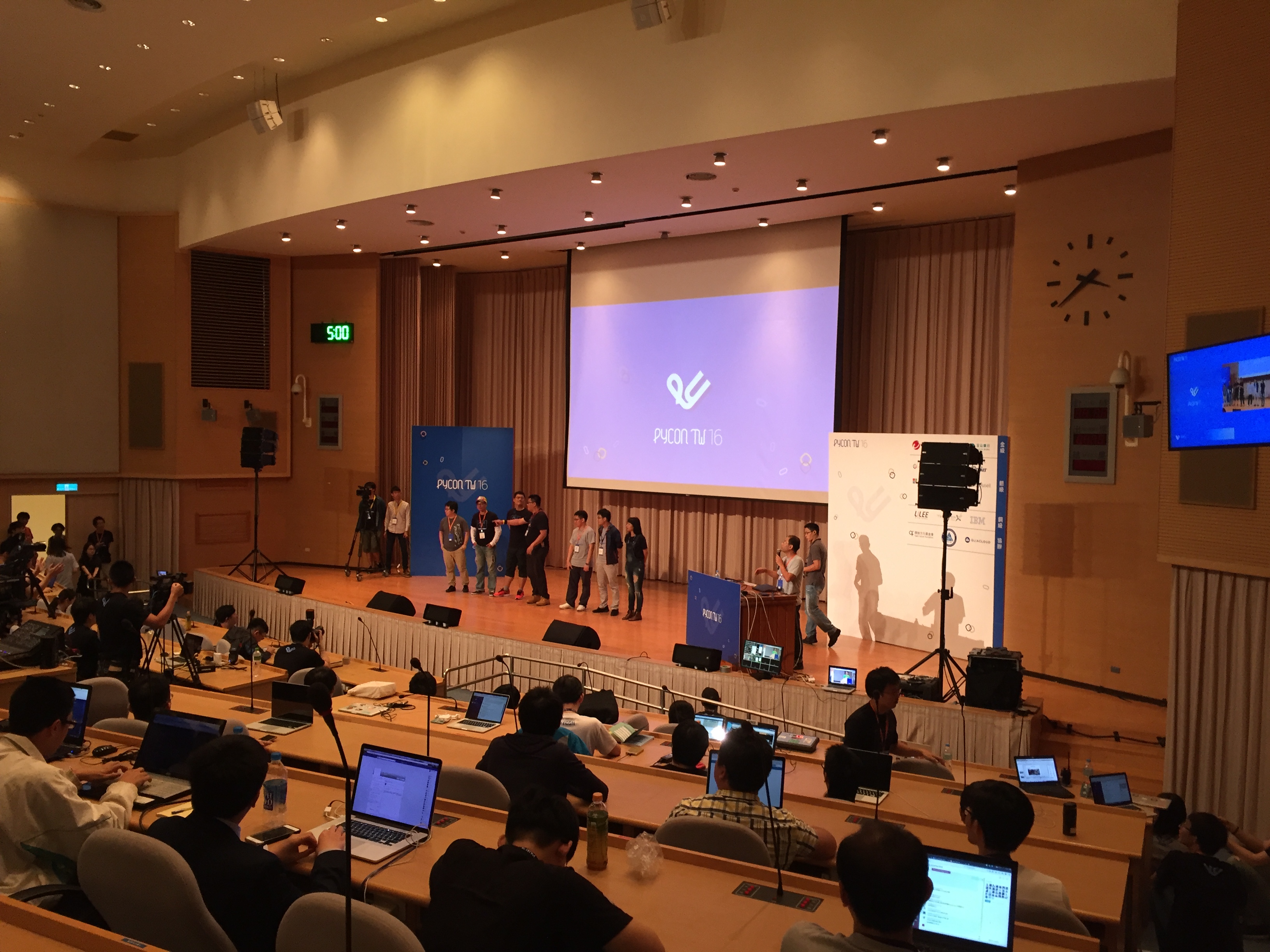
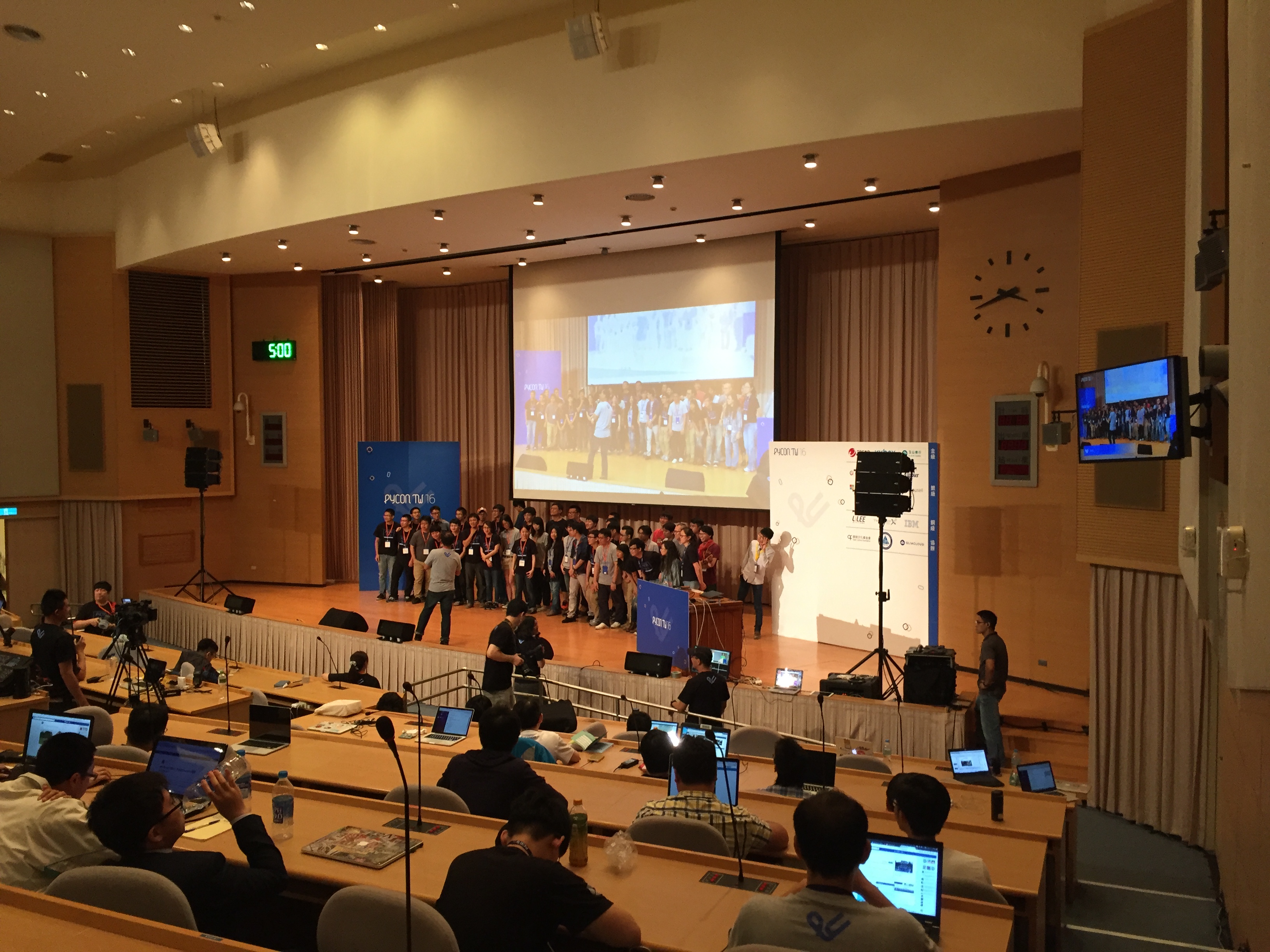
I got the feeling of class divisions during the final group photo. The chief organizer had the core members and the volunteers take photos separately, with the reason being “too many people”!? In my view, this is simply disrespectful to the volunteers, treating them as if they had a different status from the core members. If the number of people really was the issue, you can look at the two photos below. In my opinion, the people in these two photos could easily have fit together in one frame. Maybe this is a culture unique to PyCon. At least when I have volunteered at other conferences, I have rarely seen volunteers and staff being separated to do something. Everyone is one family, working together to make the event a success.